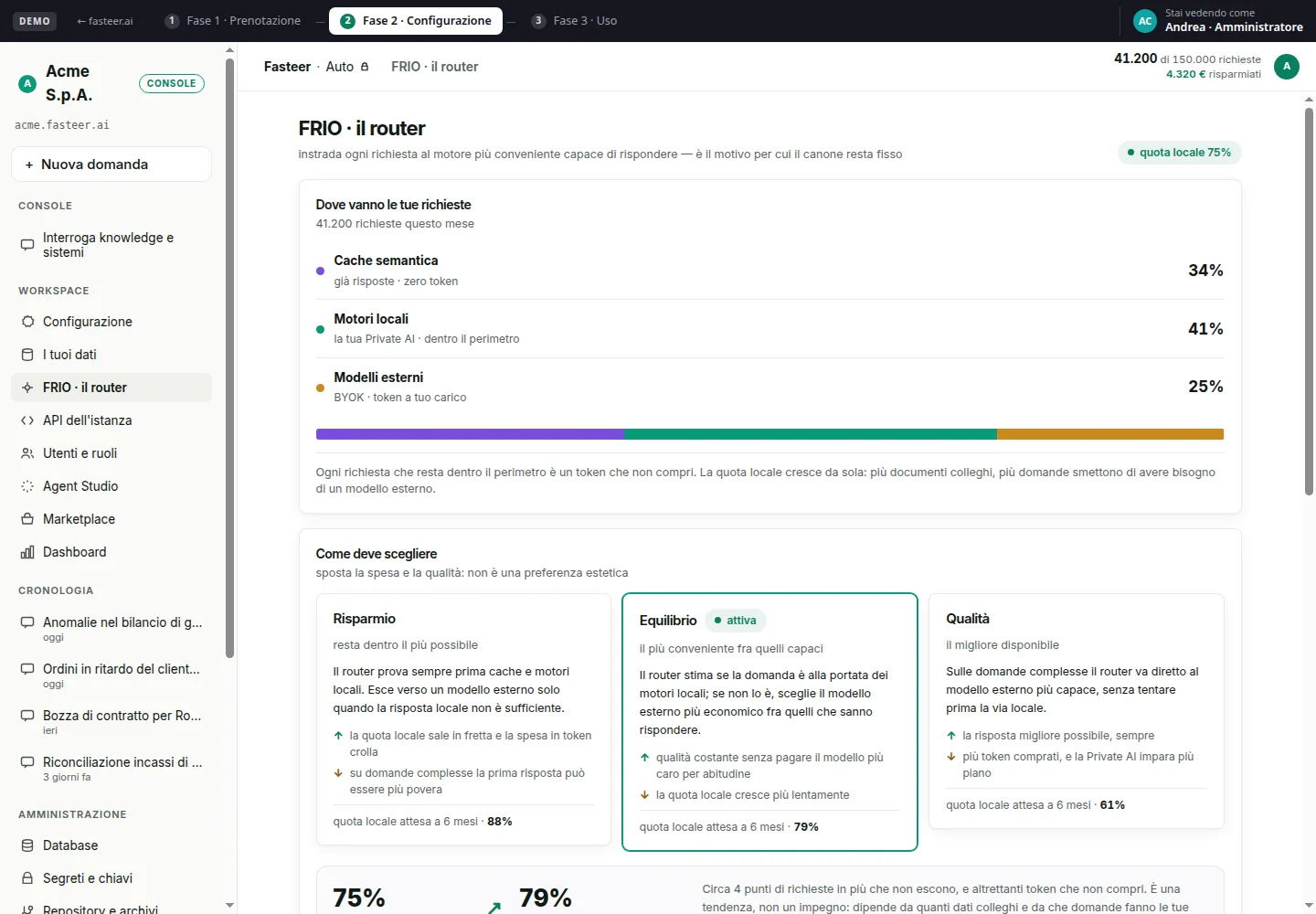
No magic: a router with a classifier, and a private AI that grows with use.
01
The FRIO router
Every request passes through a chain of checks before routing. Authentication and limits for every tenant. Sensitive-data scanning: if the prompt contains PII, the request is forced to the local engine and never leaves the perimeter. Semantic cache: if an equivalent question has already been answered, the response comes from the cache at zero cost. Then an ultra-fast classifier — milliseconds, with no network calls — decides: simple requests go to the small, cost-effective engine; the large model is used only when truly needed. And if the answer does not pass the quality check, the system safely falls back to the local engine: when in doubt, data stays in-house.
Local quota, request distribution and routing strategy can all be configured in the same console.
02
Your private AI
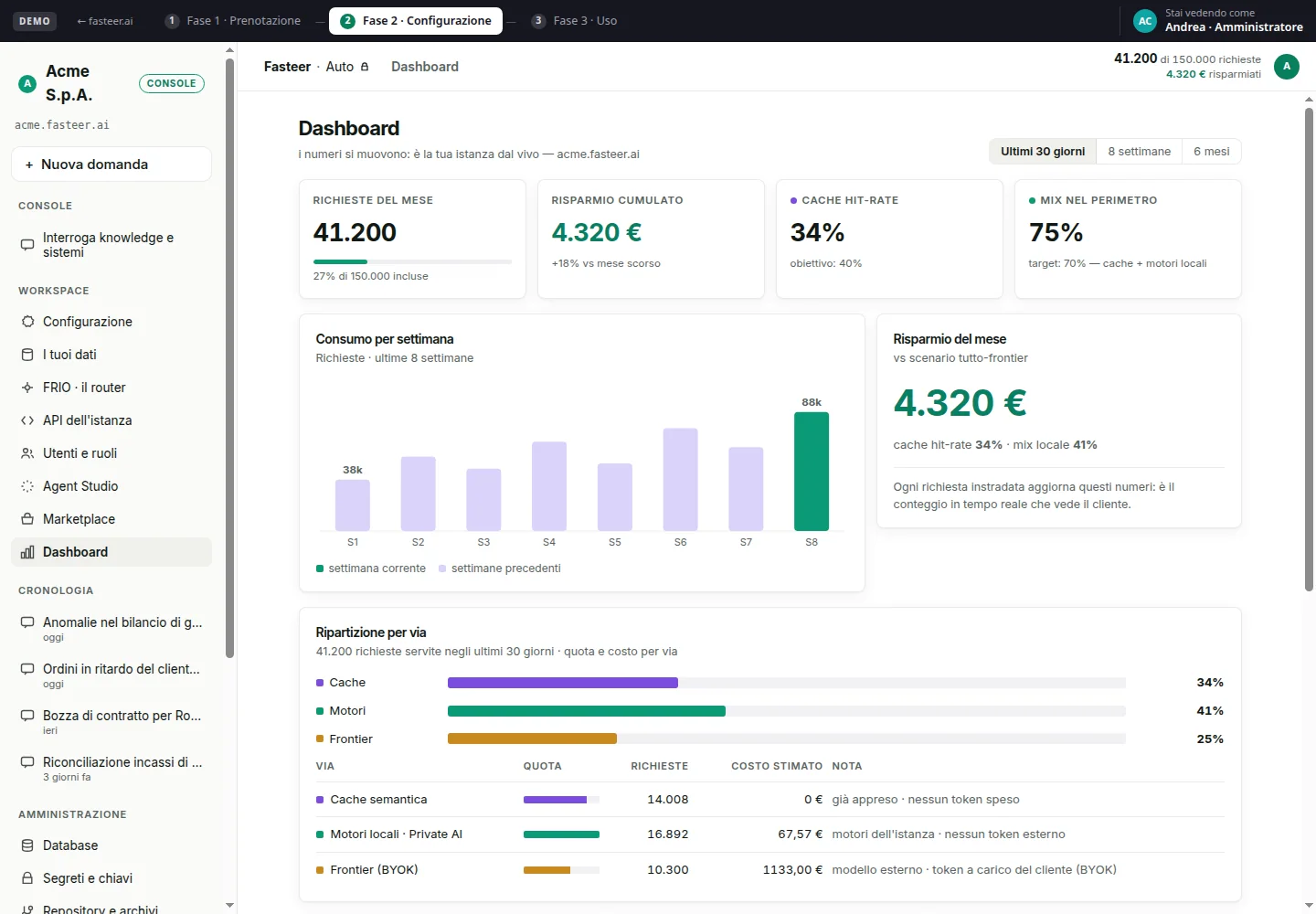
Knowledge is built from the prompts passing through the router: the system extracts, classifies and connects information in a searchable company wiki. Company documentation is added through a dedicated ingestion module. And the savings shown in the dashboard are not an estimate: they are the actual cost compared with what you would have paid by always using the large model.
Savings and engine mix, updated request by request.
03
Inside the perimeter
A dedicated instance on an EU cloud (Nebius, OVHcloud, Scaleway) in the geographical area you choose; users with role- and type-based permissions (you decide who sees what); included MCP connectors to read your systems (GitHub, CRM, ERP, drives); instance APIs to integrate everything else. Data never leaves the instance. APIs compatible with OpenAI and Anthropic standards: the apps and chatbots you already use connect by changing an endpoint, not the code. Every BYOK key has a configurable spending cap, with automatic failover between models if a provider fails.
04
What we do not promise
No guaranteed savings percentage — it depends on how you use AI today; the simulator on the homepage gives an honest estimate and the first month verifies it with real figures.